Oops! Something went wrong while submitting the form.
Date:
July 6, 2026
Last updated:
July 6, 2026
Introduction
Deel is one of the established platforms for global hiring, covering employer of record (EOR), contractor management, and payroll across more than 150 countries.
However, many businesses look for Deel alternatives once they hire into more regulated markets. In those markets, it matters whether your provider actually employs your people through its own local entity and takes on the legal liability, or routes them through a third-party partner that sits between you and your team.
This guide compares 6 Deel alternatives for 2026 on pricing, country coverage, entity ownership, and support to help you find the right fit for your team.
Top 6 Deel alternatives at a glance
Here is a quick view of 6 Deel alternatives, their core strengths, best-fit use cases, and starting prices.
Tool
Core Strength
Best For
Starting Price
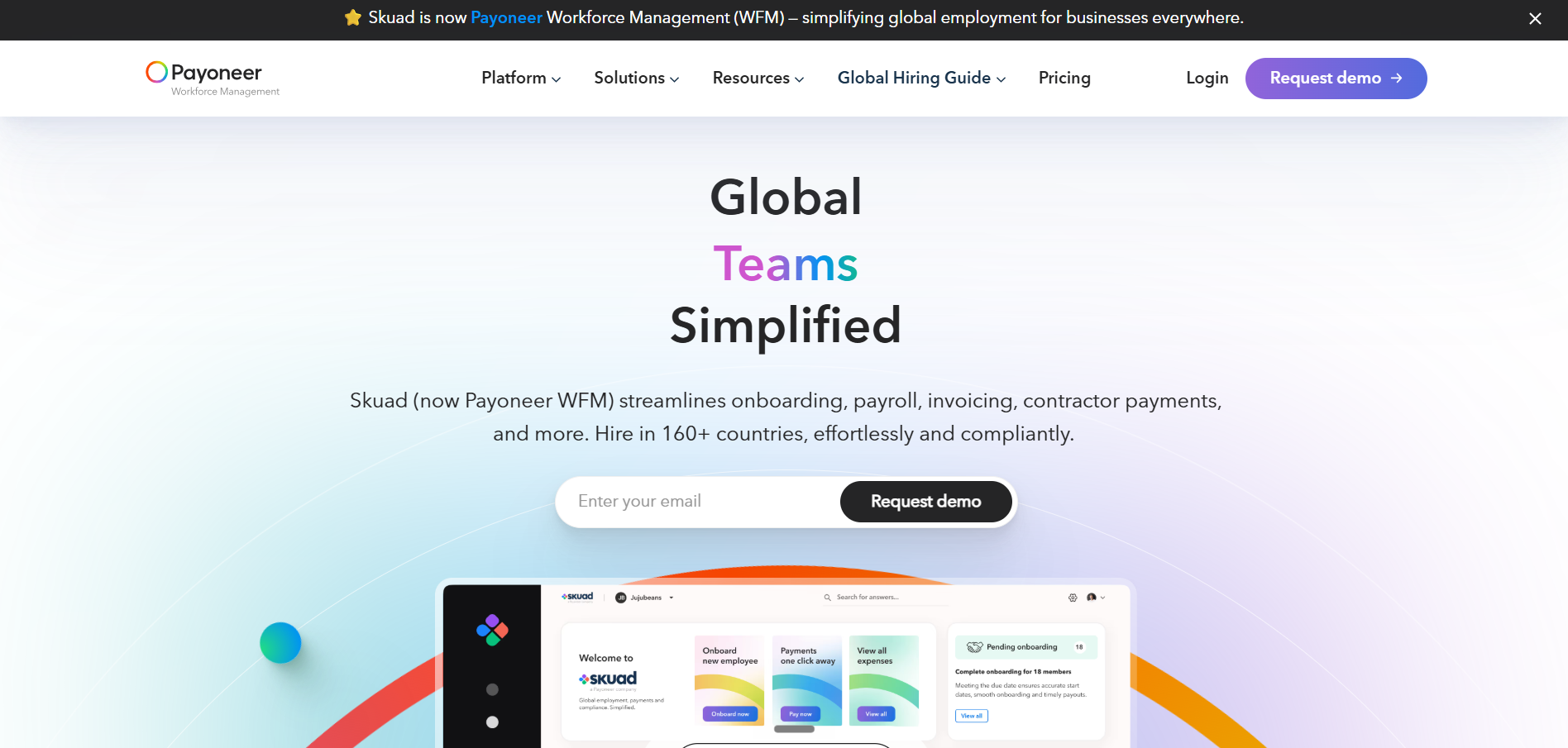
Skuad
EOR, contractor management, and payroll across 70+ currencies and 160+ countries on one platform
Startups to mid-market teams running mixed employee and contractor teams across several countries
From $199/employee/month
Multiplier
Owned entities with integrated payroll and contractor management
Cost-conscious startups and mid-market teams that want predictable costs without a sales cycle
From $400/employee/month
Globalization Partners (G-P)
Enterprise EOR across 180+ countries with deep HR-system integrations and the G-P Gia AI assistant
Enterprises buying through procurement that need wide coverage and system integration
Custom
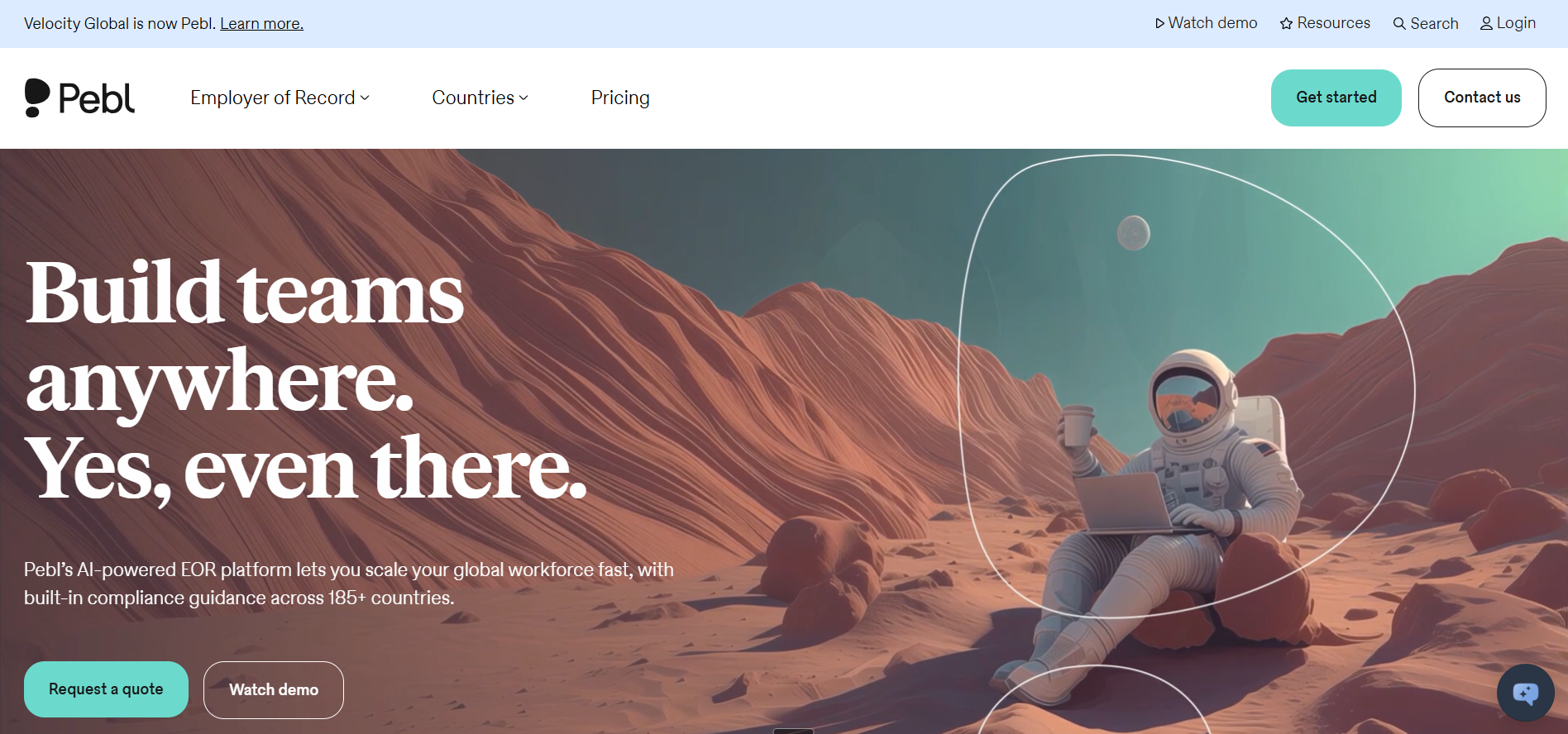
Pebl (formerly Velocity Global)
AI-assisted global hiring across 185+ markets with immigration support
Growth-stage and enterprise teams that want broad coverage plus visa support
From around $399/employee/month
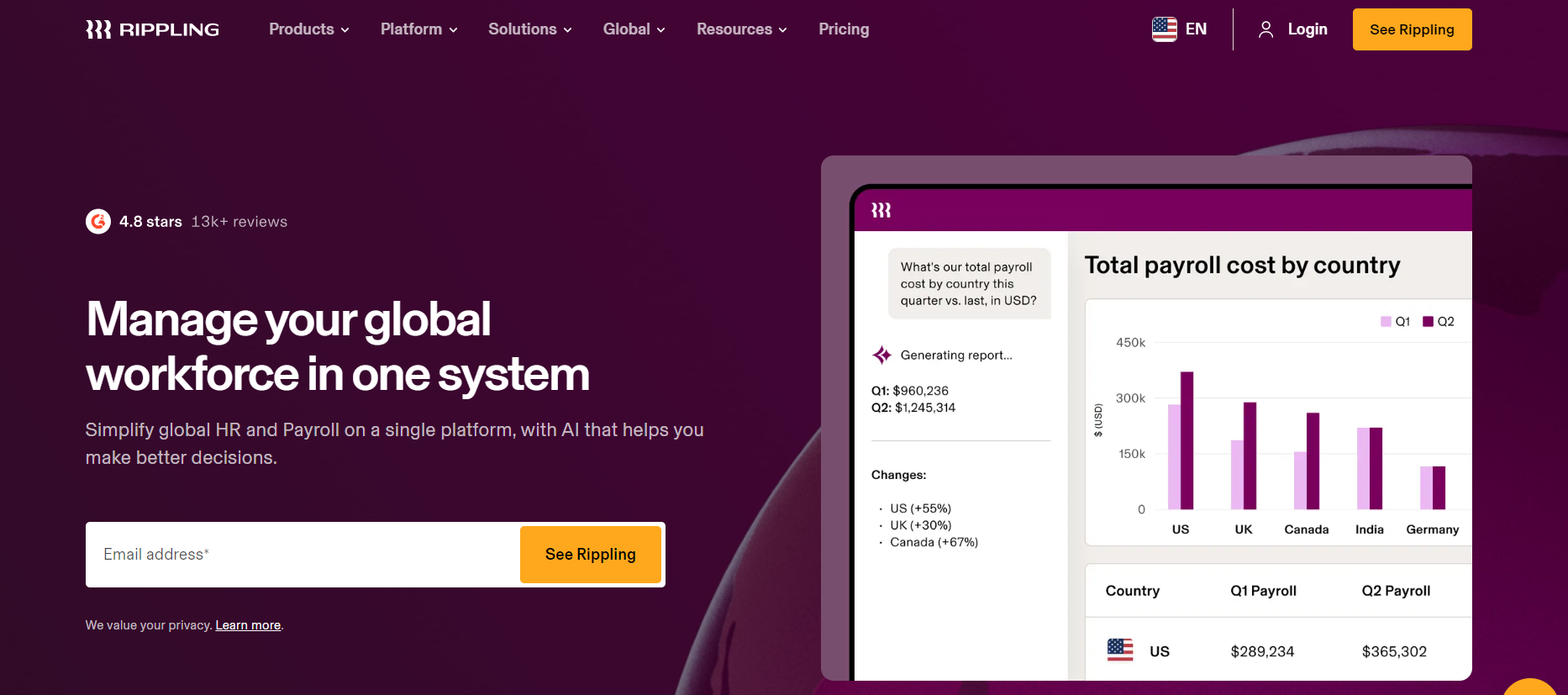
Rippling
EOR built into a unified HR, IT, and finance platform
Teams already running Rippling that want international hires inside the same system
Custom
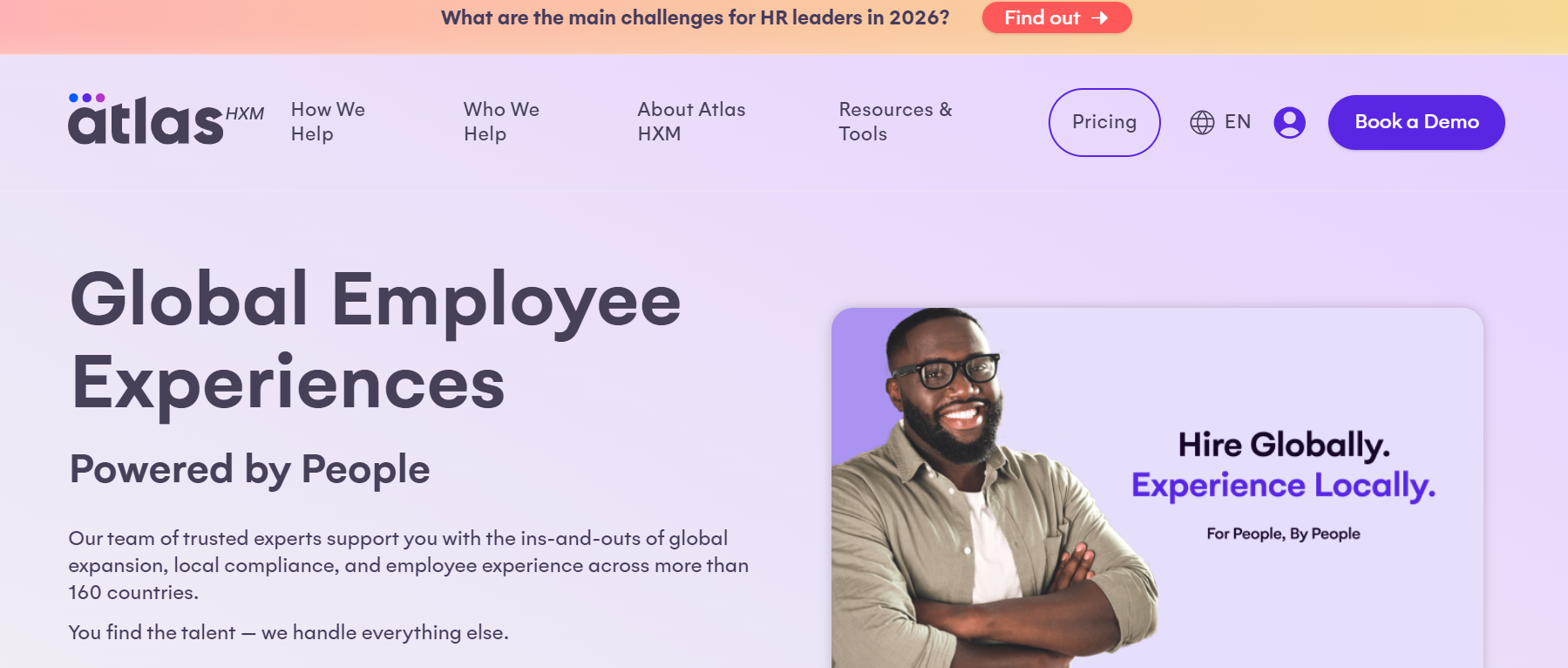
Atlas HXM
Direct EOR with owned entities in 160+ countries and in-country legal and compliance experts
Enterprise and PE-backed teams that want an owned-entity compliance chain
From $599/employee/month
The right Deel alternative depends on how well each platform supports the way a team hires. The detailed breakdown below shows where each provider is strong and where to ask more questions.
One platform to grow your global team
Hire and pay talent globally, the hassle-free way with Skuad.
Here is a closer look at the top Deel alternatives, covering onboarding, payroll, contractor coverage, compliance support, integrations, and pricing. It shows which provider fits which kind of team.
1. Skuad
Skuad is a common Deel alternative for teams that want to hire and pay people in other countries without signing up for a big all-in-one platform. It supports onboarding, payroll across 70+ currencies, statutory benefits, and compliance across 160+ countries, and covers both employees and contractors, so mixed teams stay on one system.
Localized onboarding and documentation: Supports country-specific onboarding, employment contracts, and worker records, so new hires are set up under local requirements from day one.
Payroll across 70+ currencies: Helps teams run monthly payroll across 70+ currencies, calculate employer contributions and tax withholding, and pay net salary on a fixed cycle.
Employees and contractors in one place: Beyond full-time EOR, Skuad supports Agent of Record (AOR) contractor onboarding, invoicing, and payments, which helps teams manage mixed workforces without a second tool.
Compliance and immigration support: Assists with work-permit coordination for eligible hires and ongoing compliance support as local employment rules change.
One dashboard for global teams: HR and finance teams can track worker details, approvals, invoices, and payroll from a single view across every market.
How OpenSolar built a 40-person team across three countries with Skuad
OpenSolar, a solar design and sales platform, needed engineering and commercial hires across Italy, Portugal, and the Philippines without stalling its expansion on local entity setup. Standing up entities in each market would have pulled finance into payroll reconciliation across three currencies.
The company used Skuad for unified onboarding, localized payroll in each country's currency, and one dashboard for benefits and statutory deductions, and scaled to 40 hires across the three markets. An OpenSolar executive called Skuad "a key partner in our international expansion."
Pricing: Skuad's EOR starts at $199 per employee/month, with AOR for contractors at $99 per contractor/month and the Contractor Management System (CMS) at $19 per contractor/month.
Best for: Startups, SMBs, and mid-market teams hiring across several countries that want EOR, contractor management, and payroll across 160+ countries in one platform.
Planning to switch from Deel?
Skuad can help teams move onboarding, payroll coordination, statutory benefits, and workforce management onto one platform. Book a demo now.
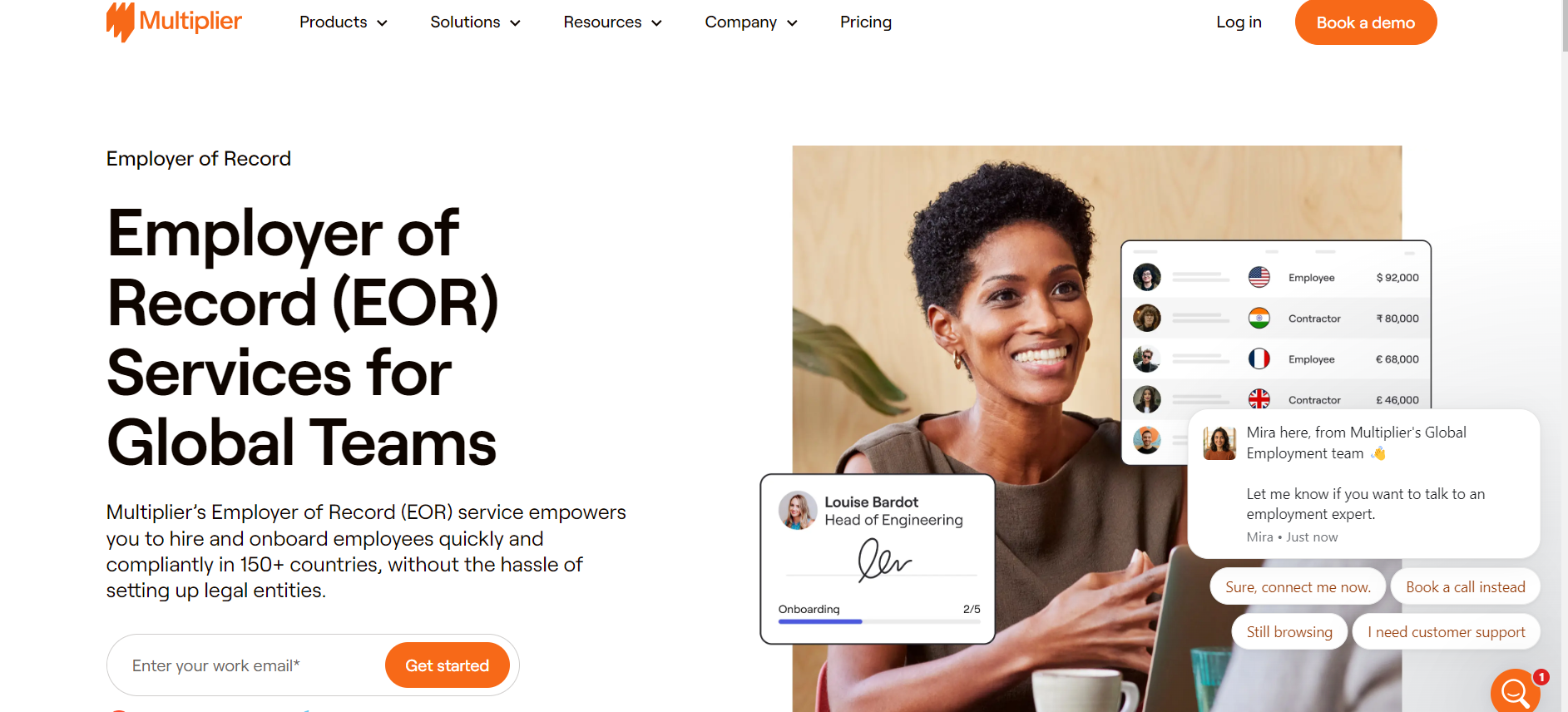
2. Multiplier
Multiplier is a global employment platform covering EOR, contractor management, and payroll across 150+ countries. It owns its local entities in most of those markets, which means one accountable team for payroll and compliance instead of a chain of third-party partners.
Owned entities and embedded compliance: Runs its own entities and builds compliance logic into hiring, payroll, and contract workflows, which reduces reliance on third-party partners.
Localized contract generation: Generates employment agreements aligned with local hiring rules for each market.
Contractor management and payments: Supports contractor onboarding, invoice automation, and multi-currency contractor payments alongside full-time hires.
IP protection: Includes Intellectual Property (IP) assignment terms in its contracts, which matters for engineering and product teams.
Pricing: EOR starts at $400 per employee/month. Contractor management starts at $40 per month.
Best for: Startups and mid-market teams that want predictable EOR costs and employee plus contractor management without a long sales cycle.
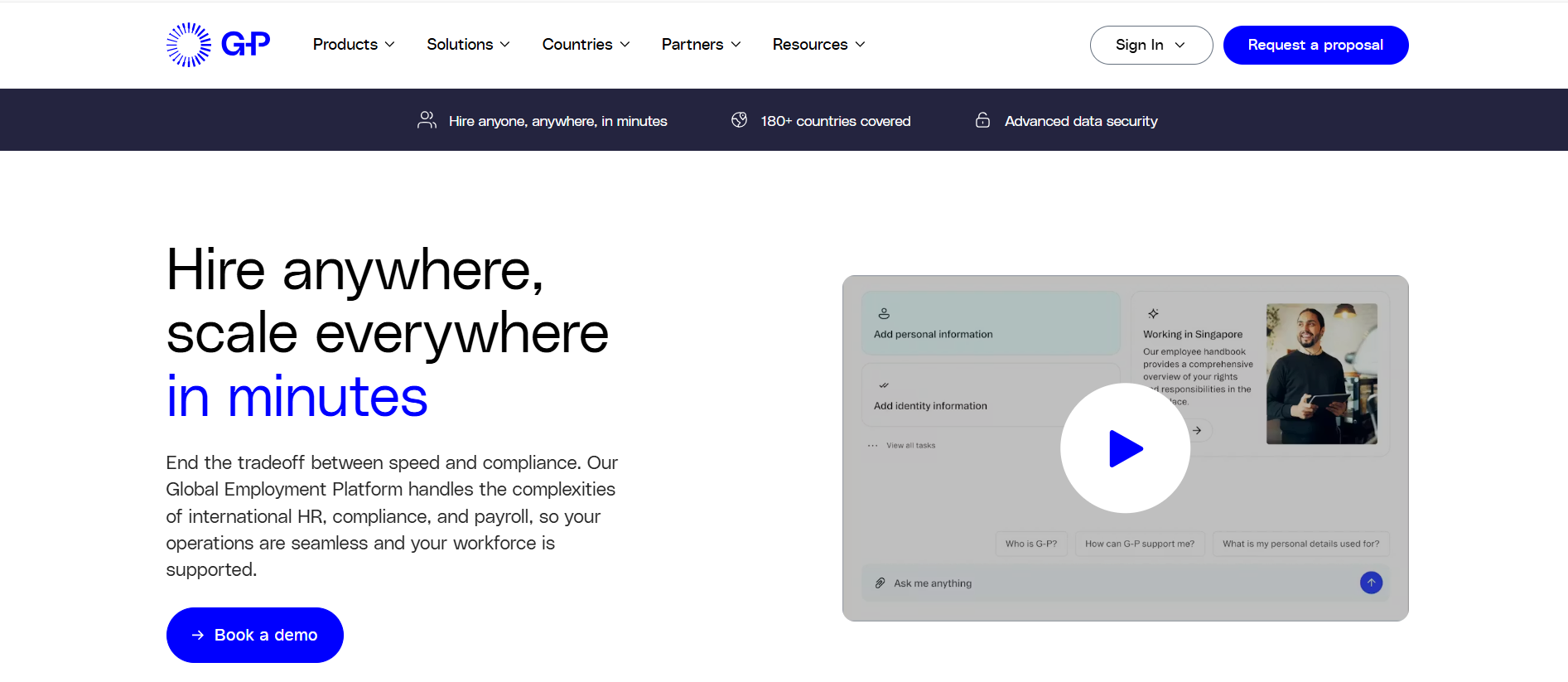
3. Globalization Partners (G-P)
G-P is an enterprise-grade EOR provider that hires and manages employees across 180+ countries, one of the widest coverage footprints on this list. It leans toward larger organizations, with deep integrations into HR systems like Workday and ADP and AI (Artificial Intelligence)-assisted compliance guidance through G-P Gia.
Coverage in 180+ countries: Helps companies hire internationally without setting up a local entity in each market.
AI-assisted HR support: Surfaces country-specific employment and compliance guidance through G-P Gia, with specialists available for more complex questions.
Localized onboarding and contracts: Supports employee onboarding, employment documentation, and country-specific worker setup.
Payroll and benefits: Covers payroll, tax deductions, and benefits administration through its EOR model.
Enterprise integrations: Connects with major Human Capital Management (HCM) and payroll systems such as Workday and ADP, so hire data flows into existing HR and finance workflows.
Pricing: Custom.
Best for: Enterprise and larger mid-market companies buying through procurement that need wide global coverage and deep integration with their HR systems.
4. Pebl (formerly Velocity Global)
Pebl is a global EOR platform with hiring and payroll coverage across 185+ markets, one of the broadest footprints on this list. It adds visa and immigration support, useful for relocating talent or hiring people who need work authorization, plus an AI assistant, Alfie, for quick answers on workforce and compliance questions. Teams that need wide coverage and strong immigration support tend to shortlist Pebl when switching from Deel.
Coverage across 185+ markets: Supports hiring, payroll, and workforce management across a wide market footprint.
AI-assisted guidance: Provides real-time answers in 50+ languages through its Alfie assistant, backed by a network of legal and hiring experts.
Immigration support: Offers visa and immigration help, useful for relocating talent or hiring non-local workers.
Hiring and payroll workflows: Brings international hiring, payroll, and workforce management into one system.
Expert-backed support: Pairs platform workflows with access to local experts for market-specific employment questions.
Pricing: From around $399 per employee/month.
Best for: Growth-stage and enterprise teams that want broad country coverage, AI-assisted workflows, and immigration support.
5. Rippling
Rippling combines HR, IT, finance, payroll, and EOR in one system, so a new international hire is connected to devices, apps, and reporting from the same record. Its EOR is a module inside that broader platform rather than a standalone product.
HR, IT, and finance in one platform: Links EOR hiring with its Human Resources Information System (HRIS), payroll, expenses, device management, and reporting.
Centralized workforce data: HR and finance teams manage employee information, payroll records, and benefits data from one system.
Device and app provisioning: Teams can set up laptops, apps, and access during onboarding, triggered automatically from the hire record.
Global reporting: Includes centralized reporting for international hiring, taxes, and workforce planning.
Workflow automation: HR actions can trigger IT and finance steps without manual handoffs.
Pricing: Custom.
Best for: Mid-market and enterprise teams already running Rippling that want their international hires inside the same HR, IT, and finance system.
6. Atlas HXM
Atlas HXM is a direct EOR that owns and operates its own entities across 160+ countries, rather than routing employment through third-party partners. Owning those entities gives companies a single, accountable compliance chain in each market, backed by in-country HR, legal, and payroll specialists. Atlas HXM suits enterprises that want direct control over compliance and liability as they move off Deel.
Direct, owned-entity model: Owns and operates entities across 160+ countries, which can simplify who holds employer liability.
Localized onboarding and contracts: Supports localized employment documentation and country-specific setup.
Payroll and statutory contributions: Supports payroll processing, payslips, statutory contributions, and employee payments.
Local HR and compliance support: Provides access to local HR, legal, and compliance specialists for country-specific questions.
Enterprise workforce platform: Includes analytics, reporting, and employee self-service for running a distributed workforce at scale.
Pricing: Starts at $599 per employee/month, with enterprise quotes for larger teams.
Best for: Enterprise and PE (Private Equity)-backed companies that want an owned-entity compliance chain and multilingual support across markets.
The 6 providers above all support global hiring, but they differ in how they handle entities, pricing, support, and multi-country management. The next section explains the criteria we used to compare them.
How we evaluated and compared the top Deel alternatives?
Choosing a Deel alternative usually comes down to a handful of factors that decide cost, compliance, and how hiring runs day to day. We reviewed each provider against the criteria that matter most when employing people across borders.
Entity ownership: We looked at whether the provider owns its local entities or relies on a third-party partner network, since that affects who holds employer liability and how fast issues get resolved.
Country coverage and multi-country fit: We considered how many markets each provider supports directly and how well it handles a team spread across several countries.
Support model: We weighed whether a provider offers dedicated human account managers and clear response times, or mostly self-serve tooling when something breaks.
Compliance depth: We reviewed how each platform handles local contracts, statutory benefits, tax, and audit-ready documentation.
Choosing the right Deel alternative for your team
Deel is a capable platform, and for some teams it stays the right one. For teams looking past it, though, the goal is a provider that fits how they hire now and where they are heading next, without the surprise fees or slow support that prompt teams to switch.
For teams whose next hires span several countries and who want EOR, contractor management, and payroll across 70+ currencies in one place, Skuad is a strong place to start. It helps HR and finance teams build one repeatable hiring process across 160+ countries instead of setting up a new vendor for every market.
Book a demo with Skuad to see how teams can hire, pay, and manage people worldwide from one platform.
FAQs
1. Why do companies look for Deel alternatives?
Companies look for Deel alternatives mainly over cost, support, and fit. Common triggers are pricing that gets hard to forecast, support that slows during a payroll or compliance issue, and frequent account-manager changes. Others outgrow the feature set and want a provider that matches how they hire.
2. What should I look for when choosing a Deel alternative?
Focus on five things: whether the provider owns its entities or uses a partner network, what the quoted price includes and what costs extra, coverage in the target markets, the support model and response times, and how it handles local contracts, benefits, and tax before signing.
3. Do Deel alternatives support contractors as well as full-time employees?
Most do, though the depth varies. A full platform like Skuad covers both full-time employees and contractors, so you can run a mixed team from one place instead of adding a separate contractor tool. If you mostly hire contractors, check the contractor pricing and the protections you get.
4. What is the difference between owned entities and a partner network?
An owned-entity provider runs its own legal entities, so it is the direct employer and holds compliance responsibility. A partner-network provider relies on third-party firms in some markets, adding a layer between the company and the employer. Owned entities usually mean a clearer liability chain and faster resolution.
5. Can I use an EOR alongside my existing payroll provider?
Yes, and many companies do. An EOR acts as the legal employer in countries where the company has no entity and runs payroll there, while the existing provider covers the markets already in operation. Some platforms also connect EOR hires into a broader HR and payroll system.
6. How hard is it to switch from Deel to another provider?
Switching is manageable with planning. Most Deel alternatives help you move employee records, payroll history, and contracts across, and can run payroll in parallel for one cycle so nobody misses a payment. Time the move around a pay period, check your notice terms, and confirm the provider's onboarding window.
Employ contractors and employees in 160+ countries