Oops! Something went wrong while submitting the form.
Date:
September 10, 2026
Last updated:
September 10, 2026
Key takeaways
The top 10 EOR services in Malaysia for 2026 are Rippling, Deel, Multiplier, Remote People, Pebl, Skuad, Remote, Globalisation Partners, Oyster HR, and Safeguard Global.
An EOR in Malaysia takes on EPF, SOCSO, and EIS contributions, administered by KWSP and PERKESO, letting a foreign company hire without a local entity.
EOR pricing for Malaysia ranges from $199 to $699 per employee per month, depending on the provider and included services.
Missing Malaysia's mid-month statutory deadline is costly: EPF charges interest at its own dividend rate, and SOCSO and EIS charge daily interest on late payments.
57 percent of global payroll professionals rank local compliance as their biggest operational challenge, per a 2025 industry survey.
The right EOR choice for Malaysia depends on your hiring scenario, factoring in entity model, blended workforce needs, and platform breadth beyond price alone.
Introduction
Employer of Record (EOR) services in Malaysia manage statutory contributions to the Employees Provident Fund (EPF), the Social Security Organisation (SOCSO), and the Employment Insurance System (EIS), administered by Kumpulan Wang Simpanan Pekerja (KWSP) and Pertubuhan Keselamatan Sosial (PERKESO).
All three contributions are due by the 15th of the following month, alongside a compliant employment contract and correct payroll tax withholding before a new hire's first day. An EOR takes on these statutory and contractual obligations directly, letting a foreign company hire in Malaysia without registering a local entity first.
Missing that mid-month deadline gets expensive. The EPF charges interest on late payments at its own dividend rate, while SOCSO and EIS charge daily interest on anything paid late.
Each scheme runs through its own portal and calendar, so a company running payroll for even a handful of employees in Malaysia ends up tracking three separate compliance timelines, and a missed one exposes every employee on that payroll.
In this guide, we cover the top EOR providers in Malaysia, comparing them on pricing, statutory compliance coverage, onboarding speed, platform capabilities, customer reviews, and overall fit so you can match a provider to your hiring needs.
One platform to grow your global team
Hire and pay talent globally, the hassle-free way with Skuad.
The top EOR providers for hiring employees in Malaysia in 2026 are Skuad, Oyster HR, Rippling, Multiplier, Deel, Remote, Safeguard Global, Remote People (Horizons), Globalisation Partners, and Pebl (Velocity Global).
The table below compares each one so you can shortlist the providers that match your hiring needs in Malaysia.
S.No
Tool
Core Strength
Pricing
Best For
G2 Rating
1
Skuad
Full statutory compliance + unified dashboard + 160+ country coverage
From $199/mo
All-size companies, Malaysia & SEA
4.6/5
2
Oyster HR
All-inclusive pricing + bilingual contracts
$699/mo
Mid-size to enterprise, multi-country
4.4/5
3
Rippling
Unified HR, IT & finance + 650+ integrations
Custom $499–599/mo
Tech companies needing IT + EOR bundled
4.8/5
4
Multiplier
APAC compliance depth + ESOP support
$400/mo
Startups & SMBs across APAC
4.7/5
5
Deel
Owned entities in 150+ countries + deepest platform
Most competitive pricing + owned entities in 100+ countries
From $299/mo
Cost-sensitive SMBs, APAC-focused
4.7/5
9
Globalisation Partners
100% owned-entity EOR across 180+ countries + G-P Gia AI compliance assistant
Custom quote
Large enterprises expanding into Malaysia as part of a multi-country compliance-sensitive footprint
4.4/5
10
Pebl (Velocity Global)
185+ countries + M&A (Mergers & Acquisitions) transitions support + AI assistant Alfie
$399/mo promo ($599 standard)
Enterprise multinationals, complex global workforce
4.6/5
While the comparison table gives a high-level view of pricing, strengths, and ideal use cases, the differences become clearer when you look deeper into the onboarding experience, compliance capabilities, platform limitations, and operational support of each tool.
Best EOR Services in Malaysia (2026): Detailed Overview
Each breakdown below covers four things:
What the platform does
How it handles Malaysia's statutory requirements
What it costs
Who it's actually built for
We put this list together to save you the hours it normally takes to compare EOR pricing pages, compliance claims, and reviews one by one. Each breakdown gives you what you need to make a call quickly, so your time and budget go toward the provider that actually fits your Malaysia hire
1. Skuad
Skuad is a global Employer of Record platform enabling companies to legally hire, onboard, and pay full-time employees and contractors in Malaysia without establishing a local entity.
With coverage across 160+ countries and instant onboarding capabilities, Skuad suits businesses of all sizes seeking a compliant, cost-effective path into the Malaysian market without the overhead of entity registration.
Key features
Reduce the operational burden of hiring in Malaysia: Skuad centralizes payroll, compliance, onboarding, contracts, and statutory management into one platform, helping teams avoid managing multiple local vendors or disconnected systems.
Expand across Southeast Asia without setting up local entities: Companies can hire employees and contractors in Malaysia and 160+ other countries without building in-country HR, legal, or payroll infrastructure from scratch.
Keep workforce operations centralized as teams grow: Instead of coordinating separate tools for payroll, contractor management, expenses, and benefits, teams can manage workforce operations through one system across 160+ countries.
Avoid unexpected platform and onboarding costs: Skuad offers transparent pricing with no setup fees, onboarding charges, or per-hire hidden costs, making workforce planning and budgeting more predictable for growing teams.
Pros
Onboarding is fast and genuinely easy to follow, letting a new Malaysia hire move from offer to first day on payroll without delays.
Pricing is transparent and published upfront, so finance teams can model the true cost of a Malaysia hire before a sales call.
The platform bundles EOR, AOR, and contractor management in one dashboard, so teams running a mixed workforce don't need separate vendors.
Cons
There's no dedicated mobile app yet, so HR admins managing things on the go are limited to the browser experience.
Employee benefits documentation is light on detail, so it helps to confirm specifics directly before rolling out to a new hire.
Payment processing and support responses can occasionally run slow, so plan around this during payroll-critical weeks.
Pricing: From $199/month per employee. All plans include payroll, compliance, onboarding, and benefits management, with no setup fees.
Country Coverage: 160+ countries.
G2 Rating: 4.6/5
Free Trial: No public free trial; demo available.
Legal & Compliance: EPF, SOCSO, EIS, and PCB contributions handled through local infrastructure; no local entity required on the client's side.
Onboarding Speed: 24–48 hours.
Platform Experience: Centralized dashboard covering payroll, compliance, contracts, and onboarding in one place.
Customer Support: Dedicated account management.
Best for: Companies of all sizes hiring in Malaysia and across Southeast Asia who want a single platform for multi-country EOR, payroll, and compliance at a competitive price point, along with Payoneer payment management support.
How Skuad Helped Microsense Networks Expand Across Southeast Asia
Microsense Networks wanted to expand operations across Indonesia, Sri Lanka, and Thailand while hiring contractors for technical support and management roles. This case study reflects Skuad's track record in the same Southeast Asian compliance environment Malaysia sits within, rather than a Malaysia-specific engagement. Managing compliance onboarding, localized contracts, and cross-border payments across multiple countries without building local entities became a major operational challenge.
Skuad's implementation:
Supported contractor hiring and employment compliance across Indonesia, Sri Lanka, and Thailand
Supported localized contracts and country-specific onboarding documentation
Simplified multi-currency contractor payments through a centralized platform
Helped with ongoing compliance guidance across multiple regulatory environments
Assigned dedicated account management support for both Microsense and its contractors
Results achieved:
Successfully hired and managed 9 contractors across three Southeast Asian countries
Maintained 0 compliance risk while expanding internationally
Reduced operational overhead tied to managing multiple local regulatory environments
Improved onboarding and payroll experience for international contractors across the region
Oyster HR is a global Employer of Record platform with strong Asia-Pacific coverage, enabling companies to compliantly hire and manage employees in Malaysia and 120+ countries without entity setup. The platform handles Malaysian employment contracts, EPF, SOCSO, and PCB statutory contributions, multi-currency payroll, and benefits administration through a centralised dashboard with real-time visibility.
Key features
Bilingual Employment Contracts: Provides compliant employment contracts in English and Bahasa Malaysia, meeting a key local legal requirement for Malaysian hires.
Full Statutory Management: Handles EPF, SOCSO, EIS, and PCB withholding for Malaysian employees end-to-end, with audit-ready documentation and compliance tracking built into the dashboard.
All-Inclusive Transparent Pricing: A single $699/month flat fee covers payroll, statutory contributions, compliance, onboarding/offboarding specialists, and multi-currency payroll with no hidden setup or per-hire fees.
Real-Time Payroll Visibility: Live dashboard tracks payroll, expenses, time-off, and statutory confirmations, reducing manual reconciliation for distributed HR and finance teams.
Pros
Onboarding is straightforward, and the support team is consistently described as responsive and easy to work with.
Oyster is the only B Corp-certified EOR in this category, a meaningful signal for organizations with ESG or ethical-sourcing requirements.
Every client gets a named HR people-partner for high-stakes situations like terminations or disputes, rather than a generic support queue.
Pricing is flat-rate and transparent across the board, with no hidden fees for offboarding or benefits administration.
Cons
Support response can slow down during more complex cases, so it helps to flag urgent issues clearly upfront.
The invoicing process can feel unclear at first, particularly around tax calculations and documentation.
Onboarding can run longer in certain markets, worth confirming timelines upfront for Malaysia specifically.
Pricing: $699/month per employee (single tier).
Country coverage: 120+ countries.
G2 rating: 4.4/5.
Free trial: No public free trial; demo available.
Legal & compliance: Bilingual contracts, full EPF/SOCSO/EIS/PCB handling.
Onboarding speed: Not publicly disclosed.
Platform experience: Real-time payroll dashboard.
Customer support: Not publicly disclosed.
Best for: Mid-size to enterprise companies wanting an all-inclusive, transparently priced EOR plan across multiple countries with strong compliance tooling and social proof.
3. Rippling
Rippling is an all-in-one workforce management platform that combines EOR, HR, IT, and finance functions through a unified employee database, enabling companies to hire compliantly in 80+ countries, including Malaysia, without establishing a local entity.
Key features
Unified HR, IT & Finance Platform: Rippling connects payroll, benefits, device management, and software provisioning in a single database. This means that any change to an employee record automatically cascades across all connected systems.
Automated Compliance Across 80+ Countries: Handles tax filings, payroll calculations, and statutory contributions in local currencies with automated updates when regulations change, reducing manual compliance monitoring.
650+ Integrations: Native integrations with tools like Slack, QuickBooks, Salesforce, and Greenhouse make Rippling a natural fit for companies with existing tech stacks that need EOR to plug in cleanly.
Device & IT Management at Hire: Automatically orders, configures, and ships devices to new Malaysian hires based on role templates, enforcing security policies before equipment reaches the employee.
Pros
Every employee record lives in one system, so a role change or termination cascades automatically across payroll, devices, and software access.
The interface is widely praised as intuitive, with a single login covering HR, IT, and finance in one place.
With 650+ native integrations, companies with an existing SaaS stack can plug Rippling in without replacing what they already use.
Rippling AI lets teams surface payroll insights and compliance alerts using plain language, cutting down on manual reporting.
Cons
The platform's depth means there's a real learning curve at first, especially for teams new to unified HR and IT systems.
Reporting and support response times could be faster.
Pricing: Custom-quoted.
Country coverage: 80+ countries.
G2 rating: 4.8/5.
Free trial: No public free trial; demo available.
Legal & compliance: Automated compliance, tax filings across 80+ countries.
Best for: Mid-size to enterprise tech companies that need EOR bundled with IT device management, software provisioning, and deep system integrations in one unified platform.
4. Multiplier
Multiplier is a global Employer of Record platform that manages employment contracts, multi-currency payroll in 120+ currencies, statutory contributions, benefits administration, and contractor management from a unified dashboard.
Multiplier is one of the few EOR platforms to natively support Employee Stock Ownership Plan (ESOP) management, useful for startups granting equity to international hires.
Key features
APAC-Focused Compliance Depth: Consistently recognised for strong compliance management across Asia-Pacific, with localised contract templates and statutory contribution handling.
Fast Onboarding: New Malaysian employees can be onboarded in 24–72 hours, with customer success managers frequently named in reviews for hands-on support throughout the process.
ESOP Management: Natively supports Employee Stock Option Plan administration
Pros
Onboarding cycles run 24 to 72 hours, among the fastest documented turnaround times in this list, backed by named customer success managers.
Native support for Employee Stock Option Plan (ESOP) administration makes it a strong fit for scale-ups extending equity to international hires.
Multi-currency payroll runs in 120+ currencies on a unified schedule, reducing the need for per-country payroll coordination.
Cons
Invoicing can occasionally need manual correction.
Salary payments have occasionally run behind; worth confirming payroll cutoff timelines for Malaysia specifically.
Country coverage outside APAC and the GCC is less deep than global-first competitors like Deel or Remote.
Pricing: $400/month per employee (EOR); $40/month per contractor.
Country coverage: Not stated for Malaysia in current published materials.
G2 rating: 4.7/5.
Free trial: No public free trial; demo available.
Legal & compliance: APAC compliance depth, statutory handling.
Customer support: Named customer success managers.
Best for: Startups and fast-growing SMBs expanding across Asia-Pacific who need rapid onboarding, ESOP support, and predictable flat-rate pricing without setup or offboarding costs.
5. Deel
Deel is one of the largest global EOR platforms, enabling companies to hire full-time employees and contractors in Malaysia and 150+ countries through its own owned entities, instead of third-party partners.
For Malaysian hires, Deel manages employment contracts, EPF/SOCSO/EIS statutory contributions, PCB tax deductions, payroll in local currency, benefits administration, device management, and equity compensation support.
Key features
Owned Entities in 150+ Countries: Deel operates through its own legal entities rather than third-party partners, giving clients direct compliance accountability and more consistent service quality across markets.
All-in-One Platform Depth: Manages EOR, contractor payments, device management, equity/ESOP, global payroll, and HR records in one system, reducing the need for multiple point solutions.
Free Deel HR for Up to 200 Employees: Includes employee records, org charts, and PTO management at no cost, a genuine differentiator for teams wanting HRIS functionality without paying extra.
Fast Onboarding: New foreign employees are fully onboarded in 1–3 business days, with automated compliance monitoring that alerts teams when Malaysian employment law changes.
Pros
The platform is genuinely easy to use for contract management, with a smooth, guided process from onboarding through payment.
Payments are fast and reliable once set up, which reviewers consistently point to as a strength.
Deel bundles EOR, contractor management, HRIS, device provisioning, and equity management in one place, cutting down on the number of vendors a growing team needs.
Free Deel HR is included for up to 200 employees, a genuine differentiator for teams wanting HRIS functionality without paying extra.
Cons
Foreign withdrawal and currency conversion fees can add up, especially for contractors paid frequently.
Payment validation can occasionally run behind, which can be frustrating on tight payroll cycles.
Pricing: $599/month per employee (EOR, published rate).
Country coverage: 150+ countries.
G2 rating: 4.8/5.
Free trial: Free Deel HR tier for up to 200 employees (not an EOR trial).
Best for: Companies of all sizes, especially those scaling across 5+ countries, who want the deepest EOR platform with contractor, device, equity, and HRIS features in one system.
6. Remote
Remote is a global Employer of Record platform that handles employment contracts, compliance, multi-currency payroll, benefits administration, and equity management for cross-border compensation programmes.
Remote’s compliance monitoring tools automatically alert teams when local employment law changes, reducing manual regulatory tracking.
Key features
Owned Entities, No Third-Party Partners: Operates through its own legal entities, providing consistent compliance standards and direct accountability to clients.
Transparent Flat Pricing: $599/month per employee with no hidden fees, setup costs, or minimum commitments, making budget forecasting straightforward for finance teams.
Equity & Stock Option Support: Manages cross-border equity compensation, including withholding and required regulatory reporting, enabling companies to grant stock options to Malaysian hires compliantly.
Real-Time Compliance Alerts: Monitors local employment law changes and sends automated alerts when statutory requirements update, reducing risk of non-compliance for lean HR teams.
Pros
Remote operates entirely on owned legal entities with no partner network, giving clients a direct compliance accountability chain.
IP Guard's two-step transfer process is a genuine differentiator for companies that need airtight IP ownership over employee-created work.
Remote manages equity and stock-option compensation, including withholding and regulatory reporting, for Malaysian hires.
The integrations hub, covering BambooHR, NetSuite, Xero, and Workday, is included at no extra cost.
Cons
Support response times can be inconsistent, so it's worth setting expectations on turnaround for non-urgent queries.
Payment transfers can occasionally run behind; it's worth confirming payroll cutoff windows in advance.
Country coverage isn't published specifically for Malaysia in current materials; it's worth confirming directly.
Pricing: $599/month per employee.
Country Coverage: Not stated for Malaysia in current published materials.
Platform Experience: Equity and compensation management.
Customer Support: Not publicly disclosed.
Best for: Companies that prioritise pricing transparency and predictability, especially startups building Malaysian teams as part of a multi-country APAC expansion plan.
7. Safeguard Global
Safeguard Global is an enterprise-focused global EOR provider with risk mitigation and payroll compliance expertise. It handles compliant employment contracts, statutory contributions (EPF, SOCSO, EIS, PCB), and payroll processing, with a particular focus on enterprise clients needing comprehensive legal protection and insurance integration.
Key features
Enterprise-Grade Risk Management: Purpose-built for large organisations. Emphasizes legal liability mitigation, insurance integration, and thorough compliance auditing over platform speed.
Regulatory Compliance Depth: Offers active guidance on local employment regulations, cultural hiring expectations, and regulatory changes, going beyond standard statutory filings to advisory-level support.
Integrated Insurance & Benefits: Bundles risk assessment and insurance integration into its EOR offering, a differentiator for enterprise clients needing comprehensive employee coverage from day one.
Payroll Compliance Focus: Manages EPF/SOCSO/EIS contributions and PCB withholding with emphasis on audit-readiness and regulatory accuracy, critical for multinationals operating under tight compliance mandates.
Pros
Fifteen-plus years of deep compliance expertise across complex, heavily regulated markets gives enterprise buyers real confidence.
Dedicated local in-market experts provide advisory-level guidance that goes beyond standard statutory filings.
The wide country footprint, 187+ markets, is one of the broadest in this category.
Dedicated account manager support helps resolve complex local HR issues without routing through a generic queue.
Cons
Onboarding tends to run slower than platform-first competitors, per third-party reviews.
Reporting tools trail platform-native alternatives on real-time data visibility.
Pricing: From $499/month per employee (EOR platform fee only).
Country Coverage: 187+ countries.
G2 Rating: 4.3/5
Free Trial: No public free trial; consultation available.
Best for: Large enterprises and multinationals hiring in Malaysia, where compliance rigour, legal risk mitigation, and insurance integration take priority over onboarding speed or platform sophistication.
8. Remote People (formerly Horizons)
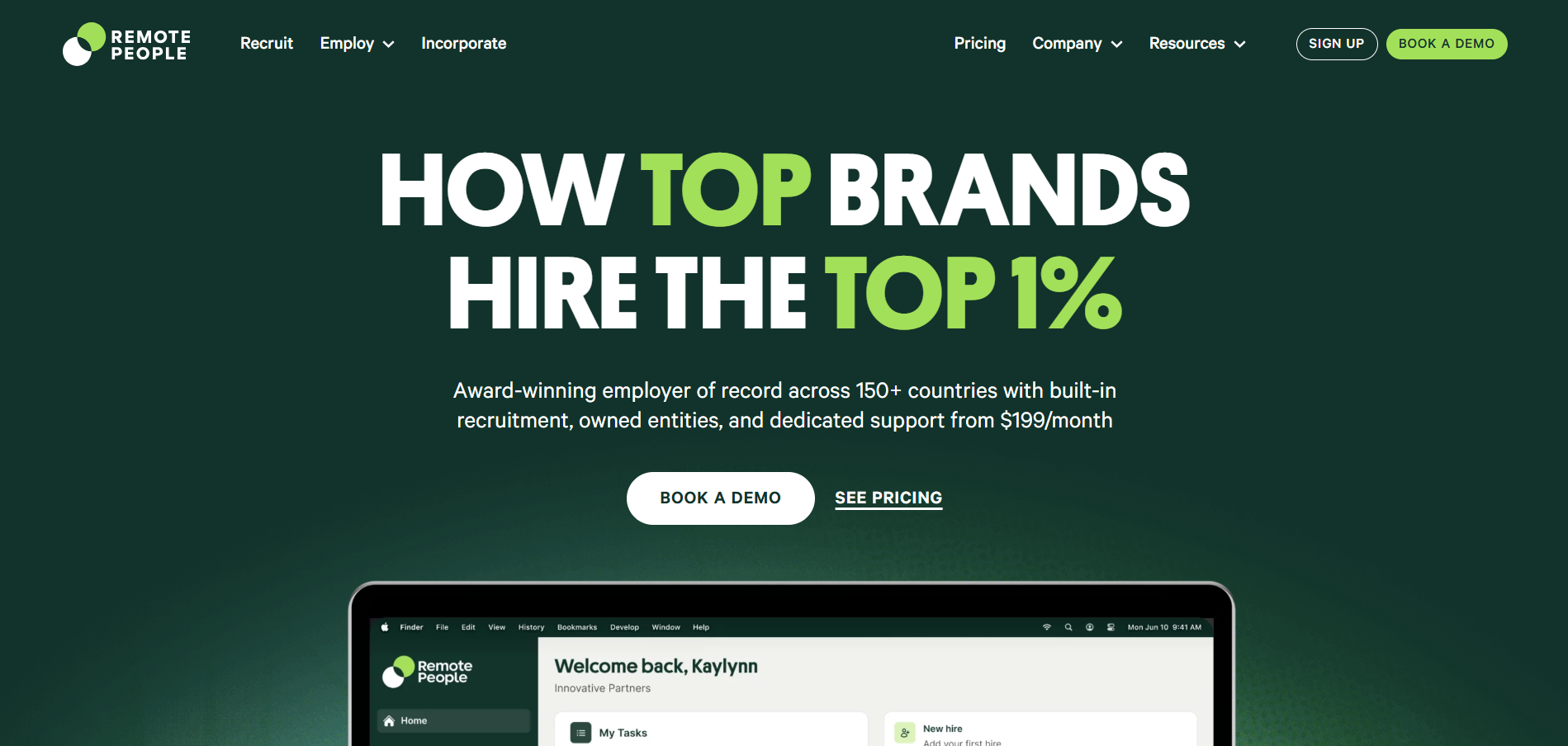
Remote People, formerly known as Horizons, is a global EOR platform that brings strong APAC familiarity, handling local payroll nuances and regional holiday variations through its owned entity structure. The platform offers an international recruitment add-on, a rare capability that allows clients to source and hire local talent through the same provider.
Key features
Owned Entities in 100+ Countries: Full compliance accountability through in-house entities backed by 130+ legal experts, no reliance on third-party partners for Malaysian EOR delivery.
International Recruitment Add-On: One of the few EOR providers that also offers international talent sourcing, allowing companies to find, hire, and employ Malaysian candidates through a single vendor.
Comprehensive Add-On Suite: Visa and immigration support, background checks, health insurance, and device provisioning available as add-ons, giving clients flexibility to expand the service as needs grow.
Pros
The published starting price of $199 per employee per month is among the most competitive on this list.
Remote People combines EOR with an international recruitment add-on, letting companies source and employ candidates through the same provider.
Full compliance accountability is backed by 130+ legal experts across its owned-entity network.
A comprehensive add-on suite, visa support, background checks, health insurance, and device provisioning, gives clients flexibility to expand the service as needs grow.
Cons
There's no free trial, only a demo or proposal request.
Onboarding, typically 48 hours after complete documentation, is solid but not the fastest option in this list.
The company says it owns entities in its highest-volume markets, so it's worth confirming the exact structure used for a Malaysian hire specifically.
Pricing: From $299/month per employee (EOR).
Country coverage: 100+ countries.
G2 rating: 4.7/5
Free trial: No public free trial; demo available.
Legal & compliance: Owns entities in the highest-volume markets. It is always better to confirm Malaysia's specific structure directly from their website.
Onboarding speed: Typically 48 hours after complete documentation.
Platform experience: Central dashboard, international recruitment add-on.
Customer support: Named account manager, 24/5 support.
Best for: Cost-sensitive SMBs and Asia-focused companies that want competitive EOR pricing, owned-entity compliance, and the option to source Malaysian talent through the same provider.
9. Globalisation Partners
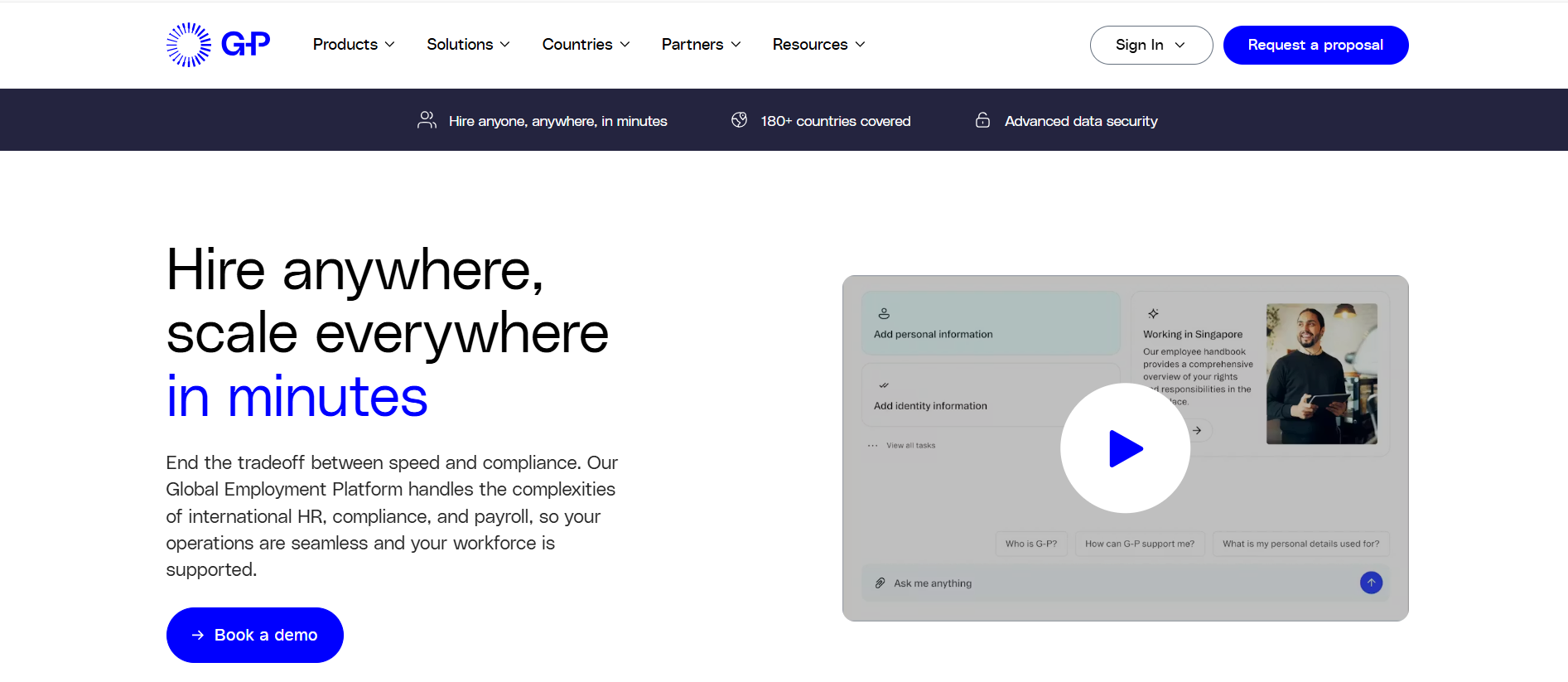
Globalization Partners, operating as G-P, is one of the original architects of the EOR model, with 13+ years of owned-entity infrastructure across 180+ countries.
G-P manages the full employment lifecycle, with locally compliant employment contracts, EPF, SOCSO, EIS, and PCB statutory contributions, payroll in MYR, benefits administration, and termination through its own legal entity in Malaysia.
Key features
100% owned-entity model in 180+ countries: G-P operates its own legal entity in Malaysia, giving clients direct compliance accountability with no partner-layer hand-offs
G-P Gia AI compliance assistant: Gia delivers real-time, expert-vetted compliance guidance across 180+ countries, generating compliant HR documents, offer letters, and employment policies in minutes, reducing reliance on external counsel for routine Malaysian employment questions.
Full Malaysian statutory compliance management: Handles EPF, SOCSO, EIS, and PCB deductions end-to-end, with automated updates when Malaysian employment law changes, reducing manual monitoring for HR teams managing multi-country workforces.
Enterprise HRIS and ERP integrations: Native integrations with Workday, SAP SuccessFactors, BambooHR, ADP, Greenhouse, and other enterprise platforms via API.
Pros
G-P operates its own legal entity in Malaysia directly, giving legal teams a single compliance accountability chain with no partner layer.
The G-P Gia AI assistant delivers real-time, expert-vetted compliance guidance and generates HR documents in minutes.
Setup is described as easy, with reviewers highlighting an intuitive onboarding layout.
Native integrations with Workday, SAP SuccessFactors, ADP, and Greenhouse make it a natural fit for enterprises already running those systems.
Cons
Support response can slow down across time zone differences, worth factoring in if your team needs same-hours coverage.
The interface feels less unified than some competitors, with certain workflows more fragmented.
Pricing is fully custom with nothing published, so companies will need a sales conversation to benchmark costs.
Pricing: Custom pricing.
Country coverage: 180+ countries.
G2 rating: 4.4/5.
Free trial: No free trial; custom quote via sales.
Legal & compliance: 100% owned entity in Malaysia, EPF/SOCSO/EIS/PCB direct.
Best for: Large enterprises and multinationals hiring in Malaysia as part of a broader compliance-sensitive global footprint, where owned-entity infrastructure, enterprise integration depth, and AI-powered compliance support take priority over entry-level pricing.
10. Pebl (formerly Velocity Global)
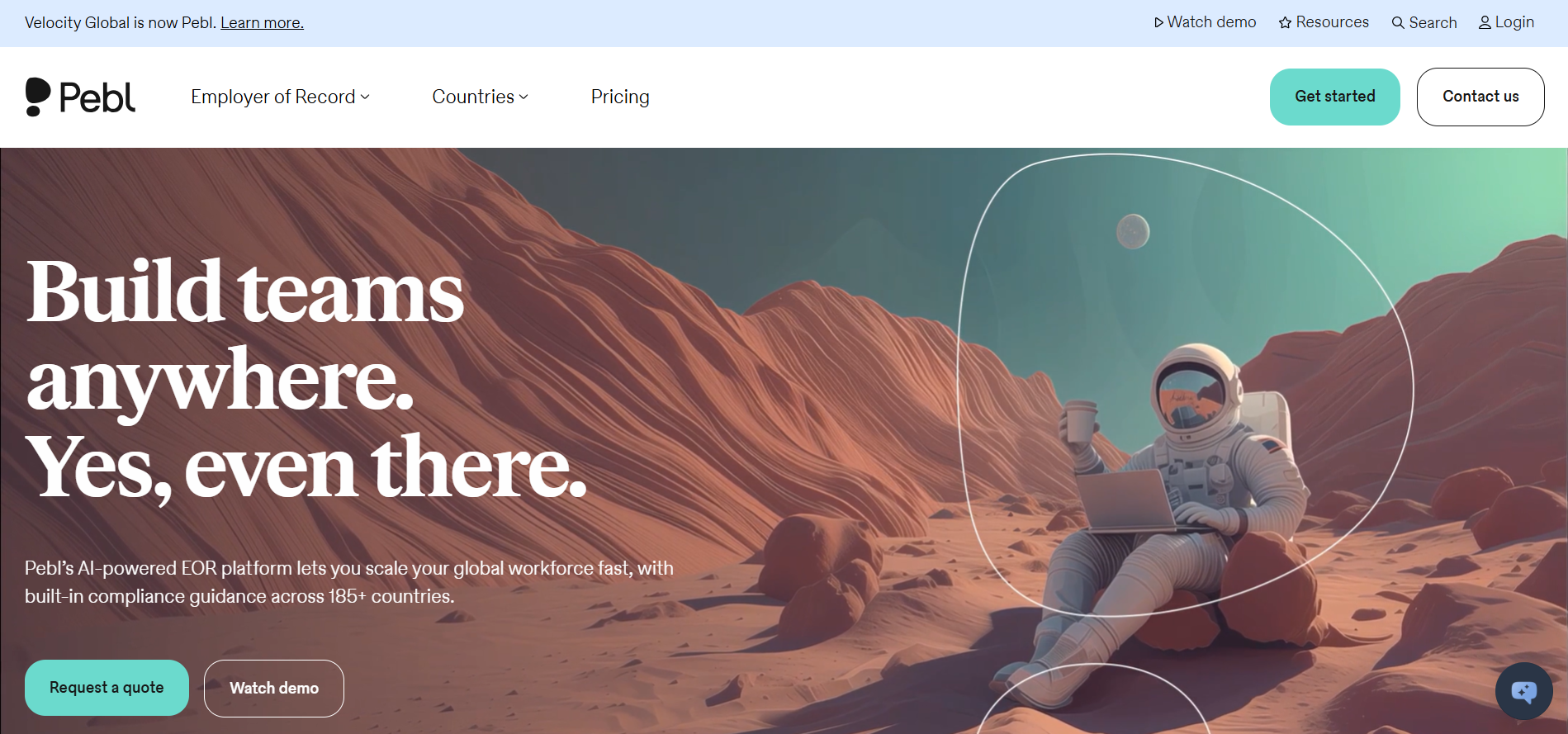
Pebl, formerly Velocity Global, manages employment contracts, statutory contributions, payroll, benefits, and visa/immigration support through its AI-first platform.
Now, it includes an AI hiring assistant (Alfie), upfront cost estimation, and self-serve onboarding workflows. It is best suited to multinationals and enterprise buyers who need breadth of coverage and immigration depth over cost efficiency.
Key features
M&A and Entity Transition Support: Handles complex workforce transitions, including mergers, acquisitions, and entity conversions in Malaysia and globally.
AI-Powered Platform (Alfie): AI hiring assistant (Alfie), upfront cost estimates, and self-serve capabilities, reducing administrative friction for HR teams managing global headcount.
Immigration & Visa Depth: End-to-end visa and work permit management for Malaysia integrated into the EOR service, covering foreign nationals relocating to Malaysia as part of the employment lifecycle.
Major HRIS Integrations: Native integrations with leading HR and payroll systems, supporting enterprise clients with complex existing tech stacks.
Pros
The AI compliance assistant, Alfie, gives fast, vetted answers to routine questions, reducing the need to route every query through outside counsel.
Onboarding is described as smooth and quick, with a genuinely intuitive interface for first-time users.
Pebl holds more employment licenses than most competitors and is rated highly for compliance on G2, which matters for regulated industries.
Support is prompt and professional, particularly useful during complex cross-border relocations or M&A workforce transitions.
Cons
Response times can slow during high-volume periods, so timelines may stretch during peak onboarding season.
Benefits packages run more limited in a few markets, worth checking country-specific coverage before committing.
Parts of the interface have room to grow, with certain screens less intuitive than the onboarding flow itself.
Pricing: $399/month per employee. Standard pricing is $599/month. Add-ons (visa support, HR consultations, expense management) are priced separately.
Platform experience: AI assistant Alfie, self-serve workflows.
Customer support: Not publicly disclosed.
Best for: Enterprise companies and multinationals running Malaysia as part of a large global workforce, particularly those needing deep M&A support, immigration handling, and 185+ country coverage.
The overviews above show what each platform does. However, it doesn’t show how each one was assessed, the specific Malaysia compliance dimensions, the evaluation methodology, and the reasoning behind every shortlist decision. That's what the next section covers.
How we evaluated the top EOR service providers in Malaysia
We evaluated the top EOR providers in Malaysia on five factors, not feature lists alone: Malaysian statutory compliance, pricing transparency, payroll and workforce management, business fit, and onboarding speed.
Each factor is broken down below, covering how a provider handles EPF, SOCSO, EIS, and Potongan Cukai Berjadual (PCB) tax deductions, what a hire actually costs once fees and add-ons are included, and how quickly a signed offer turns into a first day on payroll.
Here is how we conducted our evaluation:
Malaysian compliance coverage: Each provider's handling of EPF, SOCSO, EIS, PCB tax deductions, employment contracts, and local labor law requirements was verified.
Pricing transparency: Total costs were compared, including onboarding fees, immigration support, insurance, payroll processing, and add-ons to identify hidden charges.
Payroll and workforce management: Each platform's ability to manage contracts, benefits, expenses, and employee records across multiple countries from a single dashboard was tested.
Business fit: Providers were categorized by ideal use case. Startups making first international hires vs. enterprises managing large distributed workforces.
Onboarding speed: How quickly each platform can move a new Malaysian hire from signed offer to first day on payroll once documentation is complete, since delays here directly affect how fast a company can actually start work.
Every platform on this list was held to the same five criteria, but criteria alone don't make the decision. The right EOR for Malaysia depends on how those criteria map to your specific hiring scenario, headcount, and growth timeline. The section below helps you make that match.
PEO vs. EOR in Malaysia
An EOR becomes the legal employer of a company's Malaysian hires and takes on full compliance responsibility for EPF, SOCSO, EIS, and PCB filings, without the company needing any legal presence in Malaysia.
A PEO works differently: it acts as a co-employer alongside the company's own entity, so a registered legal entity in Malaysia has to exist before a PEO arrangement is possible.
That difference also changes hiring speed. An EOR can onboard a first employee within days, while a PEO only becomes usable once entity setup is complete, a process that typically takes months. More on PEO vs. EOR is mentioned below.
Factor
EOR in Malaysia
PEO in Malaysia
Legal entity required
No
Yes, must already exist
Who's the legal employer
The EOR
Shared, co-employment
Time to first hire
Days
Only usable after entity setup (months)
Best for
Companies with no Malaysian entity yet
Companies that already have one and want to outsource HR admin
How to Choose the Right EOR Service in Malaysia
The right EOR service in Malaysia depends on your hiring scenario, not a single best-overall provider. A company making its first Malaysian hire without a local entity needs different capabilities than one expanding across Southeast Asia, blending contractors with full-time staff, offering equity to hires, or bundling EOR with HRIS and IT provisioning.
Compliance management carries the most weight in that decision. According to PayrollOrg's 2025 Getting the World Paid survey, 57% of global payroll professionals ranked ensuring local compliance as their biggest operational challenge, which makes reliable in-country expertise and payroll accuracy the deciding factor for many companies evaluating EOR providers in Malaysia.
The table below breaks down which providers best match six common hiring scenarios, from a first Malaysian hire to enterprise expansion in regulated markets.
Hiring Scenario
What Matters Most
Best Shortlist
First Malaysian hire, no existing entity
Fast onboarding, full EPF/SOCSO/EIS/PCB coverage, transparent PEPM pricing
Skuad, Multiplier, Remote People
Malaysia is part of a multi-country SEA expansion
Single-platform coverage, owned-entity depth, repeatable onboarding workflows across APAC
Skuad, Deel
Blended workforce: full-time employees + contractors in Malaysia
Single dashboard for all worker types, multi-currency payroll, and classification compliance
Skuad, Deel, Remote
Startups offering equity to Malaysian hires
ESOP and stock option support, transparent flat-rate pricing, fast onboarding
Multiplier, Deel, Remote
EOR + HRIS + IT provisioning on one platform
Native HRIS, device and app management, 650+ integrations with finance and HR stack
Rippling
Budget-constrained SMBs expanding across APAC
Entry-level PEPM, owned-entity coverage, no minimum headcount
Skuad, Remote People
Enterprise hiring in compliance-sensitive or regulated markets
100% owned entities, enterprise HRIS integrations, AI compliance assistant
G-P, Pebl, Safeguard Global
Expert Tips for Hiring in Malaysia
Hiring compliantly in Malaysia comes down to four things: budgeting statutory contributions correctly, applying the right labour law for the employee's actual work location, using a clear written employment agreement, and planning payroll and leave around Malaysia's statutory deadlines.
Budget for statutory contributions correctly: For Malaysian citizens and permanent residents under 60, employer EPF contributions are generally 13% for monthly wages of RM5,000 or less and 12% above that. Since October 2025, most non-Malaysian employees who aren't permanent residents are generally subject to a 2% employer and 2% employee EPF contribution instead. SOCSO and EIS rates depend on the worker's eligibility category, with a RM6,000 monthly wage ceiling.
Confirm which labour law applies: The Employment Act 1955 is the principal private-sector employment law for Peninsular Malaysia and Labuan. Sabah and Sarawak operate under their own separate labour ordinances, so the employee's actual work location can change which requirements apply.
Use a clear written employment agreement: Under the Employment Act 1955, a contract for a specified period longer than one month must be in writing. Malaysia doesn't impose a single statutory probation period, so probation, notice, benefits, and termination terms need to be stated explicitly.
Plan payroll and leave carefully: Wages are generally due no later than the seventh day after the end of the wage period. In Peninsular Malaysia and Labuan, statutory annual leave is normally 8, 12, or 16 days depending on length of service, plus 11 paid gazetted public holidays a year.
How to simplify hiring in Malaysia?
Partnering with an Employer of Record (EOR) simplifies hiring in Malaysia by taking over statutory registration, compliance filings, and payroll setup that would otherwise delay a new hire's first day.
Working with an EOR such as Skuad removes two of the biggest friction points for foreign companies: entering the Malaysian market without building local HR and legal infrastructure first, and scaling international hiring without adding compliance complexity as headcount grows.
Choosing the right EOR provider ultimately comes down to how efficiently your business can hire, onboard, pay, and support employees as global expansion grows more complex.
If you are planning to hire in Malaysia, book a demo with Skuad today and see how you can hire, onboard, and manage employees in Malaysia compliantly without setting up a local entity.
FAQs
1. What is an Employer of Record (EOR) in Malaysia?
An Employer of Record (EOR) in Malaysia is a third-party provider that legally employs workers on your behalf without you needing a local entity. The EOR manages payroll, employment contracts, and statutory compliance, including EPF, SOCSO and EIS deductions, while your company directs the employee's day-to-day work. This lets a foreign company hire in Malaysia and pay employees compliantly from day one.
2. How much does an EOR service in Malaysia cost?
EOR services in Malaysia typically cost between $199 and $699 per employee per month, depending on the provider and included services. Total employment cost also includes salary, statutory contributions such as EPF, SOCSO, and EIS, benefits, insurance, and any add-on support such as visa processing or payroll management, so the sticker price rarely reflects the full monthly cost per hire.
3. What statutory contributions does an EOR manage for Malaysian employees?
An EOR in Malaysia manages statutory contributions to EPF, SOCSO, and EIS, along with PCB tax deductions, for every employee on its payroll. Some providers also handle HRDF (Human Resources Development Fund) contributions where applicable. All statutory contributions are due by the 15th of the following month, and the EOR submits filings, payroll deductions, and compliance documentation on the employer's behalf.
4. How quickly can an EOR onboard an employee in Malaysia?
Most EOR providers onboard employees in Malaysia within 1 to 5 business days once all required documentation is submitted and verified. That includes signed offer letters, identification documents, and bank details needed to register the employee for statutory contributions and payroll. Timelines run longer for foreign nationals who need an employment pass or visa approval, since those depend on immigration processing rather than the EOR's own systems.
5. Can I hire employees in Malaysia without setting up a local company?
Most EOR companies support hiring employees in Malaysia without establishing a local legal entity, since the EOR is already registered with Malaysian authorities such as KWSP and PERKESO. The EOR becomes the legal employer and manages payroll, employment contracts, statutory contributions, and compliance obligations, while your company retains full operational control over the employee's day-to-day work and performance.
6. What is the difference between an EOR and a PEO in Malaysia?
An EOR becomes the legal employer of your workers in Malaysia and takes on full responsibility for payroll, contracts, and statutory compliance. A Professional Employer Organization (PEO) works differently: it acts as a co-employer, sharing HR and compliance duties with you, which means your company must already have a registered legal entity in Malaysia before a PEO can be used.
Linh Pham is the Lead for Global HR Operations at Payoneer Workforce Management (Formerly Skuad), based in Ho Chi Minh City, Vietnam. With over 10 years of HR experience in the Asia-Pacific region, she specialises in international talent acquisition, employee relations, and employment compliance. Linh leads the HR Operations team across 50+ countries, ensuring efficient onboarding, payroll management, and adherence to local laws for distributed teams.
Employ contractors and employees in 160+ countries